
Therapy Dogs and SNFs

Submitted by Sarah Bawcum, SPT, Decatur County Healthcare, Parsons, TN
In skilled nursing facilities, healing extends beyond traditional medical treatments. Emotional well-being, motivation, and social connection all play a role in a patient’s recovery. One increasingly recognized and effective way to support these areas is through the use of therapy dogs.
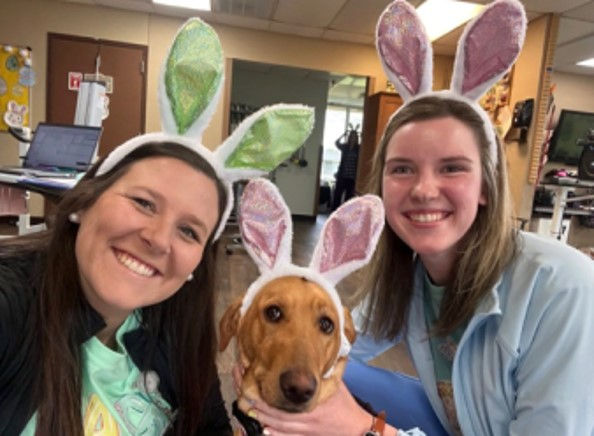
Therapy dogs, like Dolly, provide comfort, companionship, and a unique form of therapeutic engagement for patients. Their presence can reduce feelings of anxiety, depression, and loneliness — common challenges among individuals in skilled nursing settings. Even brief interactions, such as petting, talking to, or simply sitting with a therapy dog, have been shown to lower blood pressure, decrease stress hormones, and promote a sense of calm (Beetz et al., 2012; Ein et al., 2018).
Special Benefits for Stroke Patients
For patients recovering from a stroke, therapy dogs can be especially impactful. Stroke rehabilitation often involves relearning motor skills, improving speech, and rebuilding confidence. Therapy dogs naturally encourage participation in these areas in a way that feels less clinical and more enjoyable.
For example:
Motor Skills: Reaching out to pet Dolly, brushing her fur, or offering a treat can support fine and gross motor recovery (Kamioka et al., 2014).
Speech & Communication: Patients often feel more comfortable practicing speech by talking to a non-judgmental companion like Dolly, helping reduce performance anxiety (Friedmann & Son, 2009).
Motivation & Engagement: The excitement of Dolly’s visits frequently increases participation in therapy sessions and daily activities (Bert et al., 2016).
Emotional Support: Stroke recovery can be frustrating and isolating. Dolly provides consistent, unconditional companionship, helping to boost mood and resilience (Beetz et al., 2012).
Dolly in Action: Real Moments of Impact
Dolly’s presence in our facility has created meaningful, and at times remarkable, moments of care:
Promoting Safety: There have been instances where Dolly’s presence has helped prevent patient falls. Patients who might otherwise attempt to move impulsively often pause, redirect, or remain seated to interact with her, giving staff valuable time to assist safely.
Emotional Awareness: Many patients and staff have observed that Dolly seems to sense when someone is feeling down. She will gently approach, lean in, or rest beside them, offering quiet comfort that often leads to visible emotional improvement.
Instant Joy & Engagement: It is a consistent observation — when Dolly trots into a room, faces light up. Even patients who are typically withdrawn or fatigued often smile, engage, and participate more willingly during her visits.
These moments highlight something that clinical care alone cannot always provide: spontaneous joy, emotional connection, and a sense of normalcy.

Building Meaningful Connections
Dolly does more than brighten the room — she helps create moments of connection. Patients who may be withdrawn often become more engaged during her visits, sparking conversations with staff and peers. For many, interacting with Dolly brings back fond memories of pets they once had, fostering familiarity and comfort. Animal-assisted interventions have been associated with improved social interaction and reduced behavioral symptoms in healthcare settings (Bernabei et al., 2013).
Complement to Clinical Care
While therapy dogs are not a replacement for medical or rehabilitative treatment, they are a powerful complement to it. By supporting emotional health, encouraging participation, and even promoting safer behaviors, therapy dogs like Dolly enhance the overall care experience and contribute to improved patient outcomes.
References
● Beetz, A., Uvnäs-Moberg, K., Julius, H., & Kotrschal, K. (2012). Psychosocial and psychophysiological effects of human-animal interactions: The possible role of oxytocin. Frontiers in Psychology, 3, 234.
● Bernabei, V., De Ronchi, D., La Ferla, T., Moretti, F., Tonelli, L., Ferrari, B., Forlani,
M., & Atti, A. R. (2013). Animal-assisted interventions for elderly patients affected by dementia or psychiatric disorders: A review. Journal of Psychiatric Research, 47(6), 762–773.
Bert, F., Gualano, M. R., Camussi, E., Pieve, G., Voglino, G., & Siliquini, R. (2016).
Animal-assisted intervention: A systematic review of benefits and risks. European Journal of Integrative Medicine, 8(5), 695–706.
● Ein, N., Li, L., & Vickers, K. (2018). The effect of pet therapy on stress reduction: A systematic review of randomized controlled trials. Complementary Therapies in Clinical
Practice, 32, 92–100.
● Friedmann, E., & Son, H. (2009). The human–companion animal bond: How humans
benefit. Veterinary Clinics of North America: Small Animal Practice, 39(2), 293–326.
● Kamioka, H., Okada, S., Tsutani, K., Park, H., Okuizumi, H., Handa, S., Oshio, T., Park,
S., Kitayuguchi, J., Abe, T., & Honda, T. (2014). Effectiveness of animal-assisted therapy: A systematic review of randomized controlled trials. Complementary Therapies in Medicine, 22(2), 371–390.


Comments